

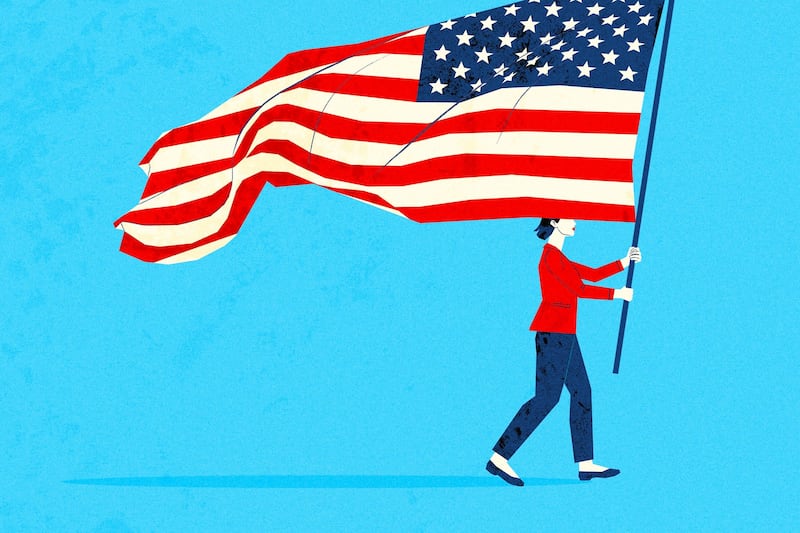

Last week, someone asked me what the big deal was about Women’s Equality Day. After that comment, I asked several other Utahns who had no idea such a day existed or understood the history behind it.
So, I decided to offer a reminder of what this day represents to women across the United States and to all who value their voices, contributions and leadership.
Every year on Aug. 26, the United States marks Women’s Equality Day, commemorating the certification of the 19th Amendment in 1920, which was the constitutional change that prohibited denying the right to vote on the basis of sex. This milestone was won through decades of organizing, sacrifice and relentless advocacy by so many women and men. Now, more than a century later, the day remains both a celebration and a reminder: “progress is possible but never guaranteed.”
The origins of Women’s Equality Day trace back to 1971, when Rep. Bella Abzug introduced a resolution to designate Aug. 26 as a national day recognizing women’s suffrage and ongoing efforts toward equality. The date itself marks the moment the 19th Amendment became law, a victory built on the shoulders of some of my heroes: suffragists like Susan B. Anthony, Nannie Helen Burroughs and countless unnamed women who organized, marched, petitioned and persisted through hostility and exclusion.
Yet even as the amendment expanded voting rights, it did not guarantee universal suffrage. Women of color continued to face literacy tests, poll taxes, intimidation and other discriminatory barriers until the Voting Rights Act of 1965 finally outlawed many of these practices. The path to equality was uneven, and the legacy of that unevenness still shapes our civic landscape today.
Why the military honors Women’s Equality Day so strongly
One of the most striking features of Women’s Equality Day is how prominently it is celebrated across U.S. military installations, often more visibly than in civilian institutions. I’ve seen this firsthand while speaking at Dugway Proving Ground and Hill Air Force Base, where service members gather to honor women’s contributions and reflect on the ongoing pursuit of equality.
There is a reason for this.
Women’s military service has long been intertwined with the fight for equality. During World War I, American women mobilized for the war effort in unprecedented numbers — working in factories, volunteering with the Red Cross, building libraries for soldiers and serving in roles that demonstrated their patriotism and capability. Their contributions became a powerful argument for suffrage, helping tip public opinion toward the 19th Amendment.
Women’s Equality Day honors the women who fought for the vote, the women who served their country without recognition, and the women who continue to break barriers today.
According to the National World War II Museum, more than 150,000 women served in the Women’s Army Corps, alongside thousands more in the Navy’s WAVES, Coast Guard SPARS, Marine Corps Women’s Reserve and the Women Airforce Service Pilots. These contributions freed men for combat roles and proved women’s skill, discipline and leadership.
The military’s recognition of Women’s Equality Day is, in part, an acknowledgment of a history in which women’s service helped expand women’s rights.
It is also a recognition of the military’s own evolution. The Women’s Armed Services Integration Act of 1948 opened the door for women to serve in the armed forces outside of wartime nursing roles. Later reforms, including the lifting of grade restrictions in 1967 and the admission of women to service academies in 1976, further cemented women’s place in military leadership.
Today, women serve in every branch, in combat roles, in command positions and in fields once closed to them. Female veterans embody the resilience, courage and determination that Women’s Equality Day celebrates. I see that resilience in my own daughter, who served for eight years in the Utah National Guard. Her service reminds me that the progress we honor on Women’s Equality Day is not abstract; it lives in the women who step forward, serve and lead.
For the military, honoring Women’s Equality Day is not symbolic. It reflects something historical, cultural and deeply personal. The challenge coins given to me by base commanders after speaking often remind me of these contributions.
Why Women’s Equality Day still matters
Utah has a remarkable history of women’s leadership. In 1870, Utah women became the first in the nation to vote under an equal suffrage law. Yet more than 150 years later, Utah ranks last in the nation for women’s equality — for the 12th consecutive year. That is simply not acceptable.
Women’s Equality Day is not just a commemoration of the past; it is a call to action. It reminds us that equality is not a finish line but a commitment; it is one that requires vigilance, investment and systems that support women’s full participation in civic life. It demands research, resources and statewide collaboration. And it depends on organizations like the Utah Women & Leadership Project, an entity that continues to illuminate the realities women face and the solutions that move us forward.
Women’s Equality Day honors the women who fought for the vote, the women who served their country without recognition, and the women who continue to break barriers today. But it also asks something of us: to ensure that progress does not stall. As I often say, when women thrive, families, communities and our state thrive too. The legacy of Women’s Equality Day is not defined by 1920. It is defined by what we choose to do now.