



This article was first published in the On the Hill newsletter. Sign up to receive the newsletter in your inbox on Friday mornings here.
Hello, friends. We’re officially halfway through 2025 and it’s been … an interesting year thus far.
There was a lot of news this week, stretching from the Oval Office to Capitol Hill, which I’ll try to unpack below with an assist from my colleague Lauren Irwin. But first, I thought it might be helpful to take a look at the elephant in the room: the upcoming midterm elections that will soon dictate everyone’s behaviors and talking points.
— Cami Mondeaux
The Big Idea: An early look at the 2026 midterm elections
It’s more than a year until Election Day on Nov. 3, 2026. But for those unaccustomed to Washington, D.C., an important note: It’s always campaign season in the nation’s capital.
Both chambers of Congress will be up for grabs next fall, and both parties are already strategizing on how they’re going to defend their slim majorities or topple their opponents to regain at least a sliver of control.
It could be too early to determine which issues will be the selling points for next year. After all, voters historically have short-term memories and it’s often the biggest news cycle closest to Election Day that sways opinions the most.
But it’s clear that Republicans and Democrats are already trying to make their jobs easier for when campaign season begins in earnest — especially for those in the most vulnerable seats.
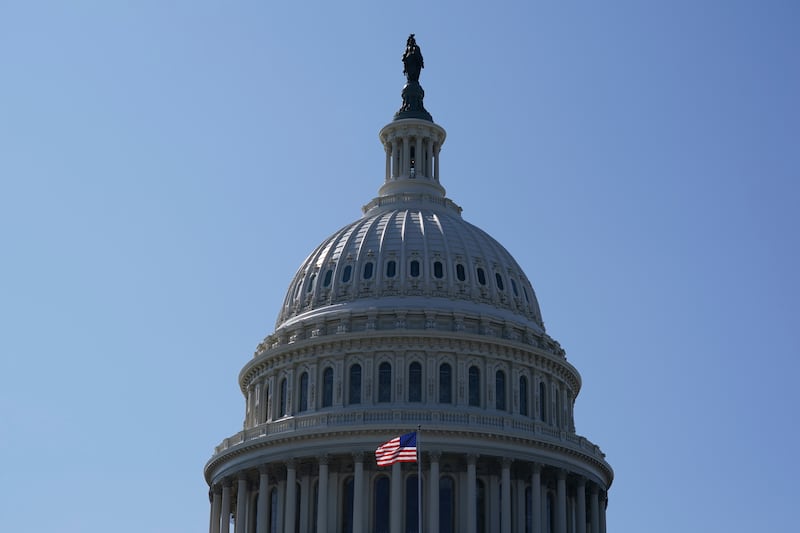
So let’s start off with the math.
Republicans currently control both the House and the Senate, albeit by the slimmest of margins.
There are 35 seats up for reelection in the Senate, where Republicans have a 53-47 majority. However, that makes it seem like there is opportunity for a bigger shake-up than there actually will be.
To put into context, only about six of these races will actually be competitive. And only two — both held by Democrats — are considered “toss-ups.” Those are the seats held by Sen. Jon Ossoff in Georgia and the open Michigan seat being vacated by Sen. Gary Peters.
So it puts Democrats in a bit of a defensive posture. Making things more difficult, they’ll also need to defend Minnesota’s and New Hampshire’s Senate seats, which will both be open next year — ridding them of any incumbent advantage.
Republicans, meanwhile, will have their work cut out for them in the House.
The party currently holds only a 220-212 majority (three seats are absent because of recent deaths, but are likely to lean Democratic) and there are a fair share of competitive races ahead.
There are 19 seats expected to be “toss-ups” in the House next year, 10 held by Democrats and nine by Republicans. But if history tells us anything, Republicans could be the ones at a disadvantage.
Historical trends show that the party of the sitting president typically loses control of the House during the midterm elections, giving the minority party an edge. One of the exceptions to that came during George W. Bush’s first term, when Republicans actually gained seats in the House after the 9/11 attacks.
Then again, Democrats had significant messaging struggles during the 2024 cycle, and it’s not clear if they’ve been able to overcome those to make any gains. But there are some clues as to what they may be looking at to help win over voters who turned against them last November.
One area they’ll likely try to work on: transgender rights. Democrats have amplified that messaging over the last several years, even though polling shows their stance on the issue has gotten less popular among voters.
Democratic Rep. Sarah McBride, who made history as the first transgender member of Congress last year, explained why she thinks Democrats lost ground on the issue.
“Candidly, I think we’ve lost the art of persuasion. We’ve lost the art of change-making over the last couple of years,” McBride told The New York Times this week. “There was a very clear, well-coordinated, well-funded effort to demonize trans people, to stake out positions on fertile ground for anti-trans politics and to have those be the battlegrounds — rather than some of the areas where there’s more public support.”
Some Democrats have already started to temper their stances on transgender issues, such as California Gov. Gavin Newsom, who is considered a top contender for the party should he choose to run for president.
Newsom made headlines in March when he admitted he believed transgender athletes playing in women’s sports was “deeply unfair” and criticized Democrats’ practice of declaring pronouns in professional introductions.
“I had one meeting where people started going around the table with the pronouns,” Newsom told conservative influencer Charlie Kirk in March. “I’m like ... ‘Why is this the biggest issue?’”
Democrats have also made it clear they plan to hammer Republicans on policy issues tucked into President Donald Trump’s tax bill — particularly those putting programs such as Medicaid or SNAP at risk.
Some Republicans have conceded the giant tax bill could put some of their members at risk. Sen. Rand Paul, R-Ky., for one, has not been shy to rail against a proposal to raise the debt ceiling by $4 trillion or $5 trillion — predicting that would later be used against them if they vote for it.
“We roll around to 2026 elections, what are they going to say? ‘Oh, Democrats, you know, they’re for borrow(ing) and spend(ing),’” Paul said. “But now the Republicans will have joined the Democrats in being for borrow(ing) and spend(ing).”
Republicans’ performance (and Democrats’, too) could depend on what Trump does over the next year and a half. We’ll look at how voters view the president so far below.
As the election season nears, I’ll be keeping a close eye on these issues. Reach out if you have specific policy questions you’re interested in or want answers from your representatives.
— Cami Mondeaux
Stories Driving the Week
- Lee in the hot seat: Sen. Mike Lee deleted a series of social media posts about a double homicide in Minnesota over the weekend after he was confronted by two of his Senate colleagues over what they said were “cruel” and insensitive posts. The Deseret News editorial board urged Lee to publicly apologize.
- Security brief: Lawmakers are pushing for increased security while in Washington and at home after those shootings in Minnesota rattled several members who say they have received similar threats in recent weeks. No decisions have been made about how to counter potential threats, but members said there was bipartisan support for increased resources.
- Tax bill trouble: Senate Republican leaders are in crunch time as they attempt to get all corners of their party to agree on key provisions of President Donald Trump’s signature tax bill. But some provisions have not been met with open arms … and could push lawmakers past their July 4 deadline.
Utahns weigh in on Trump’s job as president so far
As Trump reaches the five-month mark of his second term, much of his legacy can be described as “a frenetic pace of executive orders and action on issues related to culture as well as immigration and foreign policy,” my colleague Lauren Irwin writes.
The Deseret News conducted polling about how Utah voters feel about his term so far — here’s a recap of what Lauren found:
“A reliably red state, Utah voters generally approve of Trump’s job performance, while a sizable minority still disapproves of his action. Among those surveyed, a majority, 56%, approve of Trump’s job as president, which is up from 54% in an April survey.
“Trump still remains popular with Republicans in Utah. Nearly 80% of Utah Republicans approve of the job he’s doing as commander in chief, with 47% of them who say they ‘strongly approve’ of his performance.
“The president performs best with white Utahns, males and with Utahns who are 35-49, the survey found.
“According to the survey, 61% approve of Trump’s handling of immigration, while 35% disapprove. Republicans in the state overwhelmingly support Trump on immigration, while just 21% of Democrats approve. Independents were fairly split down the middle on Trump’s immigration policy.
“Utahns also strongly approved of Trump’s efforts to reduce the cost of government, with 59% job approval compared to 34% who don’t approve, and of his administration of the government, with 55% approval compared to 40% who don’t approve.”
Read Lauren’s full analysis here.
— Cami Mondeaux and Lauren Irwin
Quick hits
From the Hill: Senate Democrat pushes to restrict U.S. military involvement in Iran. … Majority of Utahns support DOGE spending cuts. … House Republicans launch an investigation into LA riots.
From the White House: Trump administration eyes Greenland over security concerns. … Trump Organization launches smartphone. … Key moments from the U.S. Army’s 250th birthday event.
From the courts: Supreme Court upholds ban on medical treatment for transgender minors. … SCOTUS orders review over religious challenge to New York abortion law.
What’s next
The House will be back next week. The Senate will continue deliberations on Trump’s “big, beautiful bill.”
Senate Majority Leader John Thune, R-S.D., hopes to bring that package up for a vote sometime next week. But some Republicans are balking at the suggestion, arguing they need more time to hash out the details.
As always, feel free to reach out to me by email with story ideas or questions you have for lawmakers. And follow me on X for breaking news and timely developments from the Hill.