

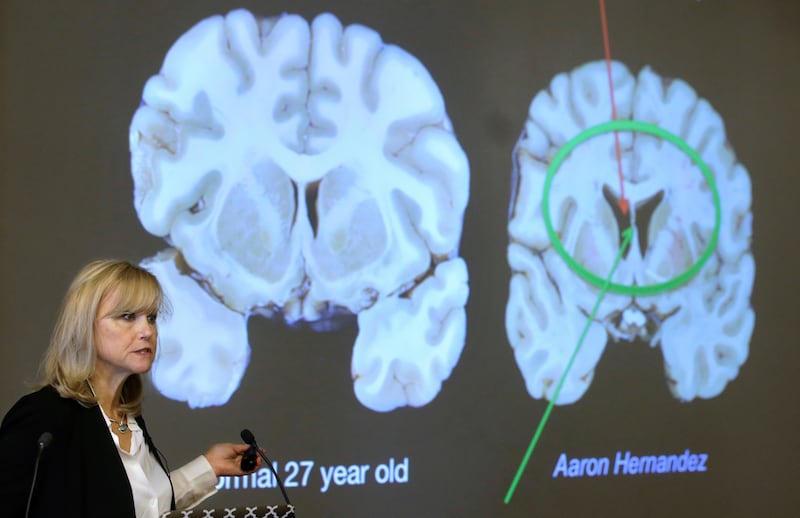

- A new study found that 1 in 4 former NFL players who died from 2016 to 2021 had CTE.
- Chronic traumatic encephalopathy is a brain disease linked to repeated head impacts.
- Researchers say the prevalence of CTE is a wake-up call for the NFL and scientific communities.
New research found a significant number of former NFL players who died from 2016 to 2021 had the degenerative brain disease known as CTE.
At least, nearly a quarter of all former players who died during that six-year period had confirmed chronic traumatic encephalopathy or CTE — a neurodegenerative disease linked to repeated head impacts — at death, according to the study published Tuesday in the British Medical Journal.
“We’ve known that this disease process can be caused by, in part, repeated traumatic brain injury. But we didn’t know how common it was,” said Dr. Daniel Daneshvar, chair of physical medicine and rehabilitation at Mass General Brigham and the study’s lead author.
CTE can only be diagnosed after death. Most studies about the disease have relied on brains donated to researchers by families or by individuals themselves, many of whom had seen or experienced symptoms, such as memory loss or major mood swings, that led them to believe they might have the disease, per NPR.
A wake-up call for the NFL
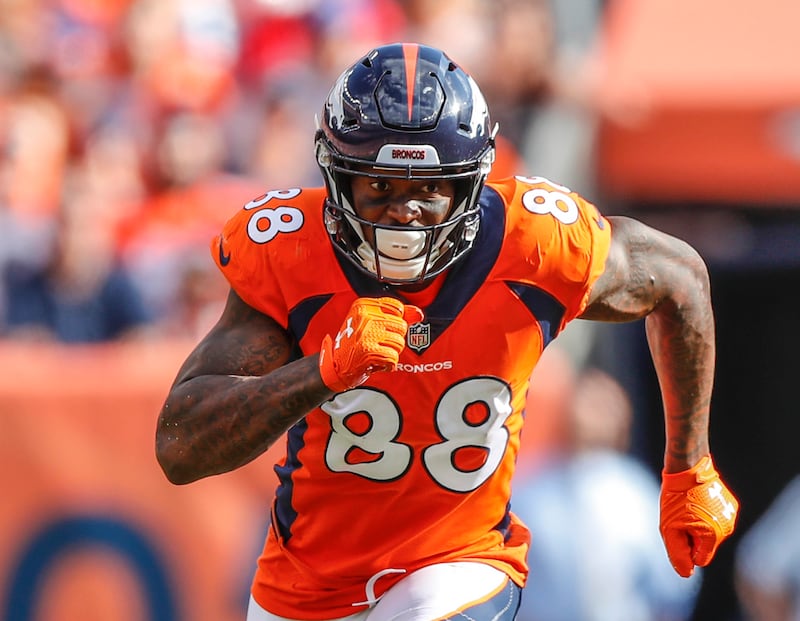
For the study, researchers at Boston University and Harvard Medical School analyzed brains that were donated to the UNITE Brain Bank at the Boston University CTE Center and Mount Sinai and University of California San Francisco Alzheimer’s Disease Research Center brain banks.
Over the six years from 2016 to 2021, the highest donation period, 878 NFL players died. Of those, 215, or 24.5%, were diagnosed with CTE, which researchers called a conservative estimate. They say the actual rate could be as high as 97.7%, depending on how many players whose brains were not examined after death also had the disease.
The true prevalence likely lies somewhere in the middle, researchers said.
“Community brain bank studies have shown that CTE affects less than 1% of the general population,” Daneshvar said in a Mass General Brigham press release.
“To find that somewhere between 24.5% and 97.7% of NFL players from that time period had this progressive brain disease is a wake-up call for the NFL and scientific communities.”
The researchers also found that dementia was common among the study’s brain donors. Among donors with CTE, 61.3% had dementia diagnosed by study clinicians based on medical records and informant reports. That number rose to 90.4% for donors with the most severe form of CTE, known as Stage IV.
“Together, these findings indicate that NFL players have a higher prevalence of CTE at death than has been previously shown in multiple community-based studies. Furthermore, these data indicate that CTE severity at death is significantly associated with dementia in NFL player brain donors, and that dementia is common in these donors,” according to researchers.
NFL Players Association reacts to CTE study
The NFL Players Association, which funds research about CTE at Boston University and other studies of football-related health issues, issued a statement regarding the study.
“This study is a sobering reminder that football carries real risks, and those risks can have lasting consequences for players and their families. It also reinforces one of the NFLPA’s core priorities: improving player safety and supporting players throughout their lives, both during and after their careers,” according to the NFLPA.
“The findings should serve as a call to action across the entire football ecosystem. We all share a responsibility to advance research, improve access to care, develop better treatments, and support those affected by the long-term impacts of the game.”
Dr. Jess Mez, associate professor of neurology at the Boston University Chobanian & Avedisian School of Medicine and co-director of clinical research at the Boston University CTE Center, said researchers recognize that the findings will be concerning for NFL players and their families, and noted that help is available.
“We have treatments for many symptoms believed to be associated with CTE, and in our clinic we find that symptoms can improve with proper medical care,” he said.
Facing the next challenge
The study provides one of the most informative estimates to date of CTE burden among former NFL players, researchers said in an editorial linked to the findings. But no single study is likely to fully define the epidemiology of CTE or the contribution of playing in the NFL to the development of the disease, they said.
The next challenge, they said, is not simply to establish whether repetitive head impacts have long-term neurological effects, but to quantify those consequences well enough to inform athletes, clinicians, sporting organizations and policymakers.
Researchers say that will require recruitment and follow-up of players from the onset of their careers, ideally starting from high school or college football teams, and potentially matched to a control group of non-football players with similar characteristics.
They noted that future studies should examine athletes who played more recently, and that prevention efforts should focus on reducing repetitive head impacts that drive CTE risk, not just concussions.