

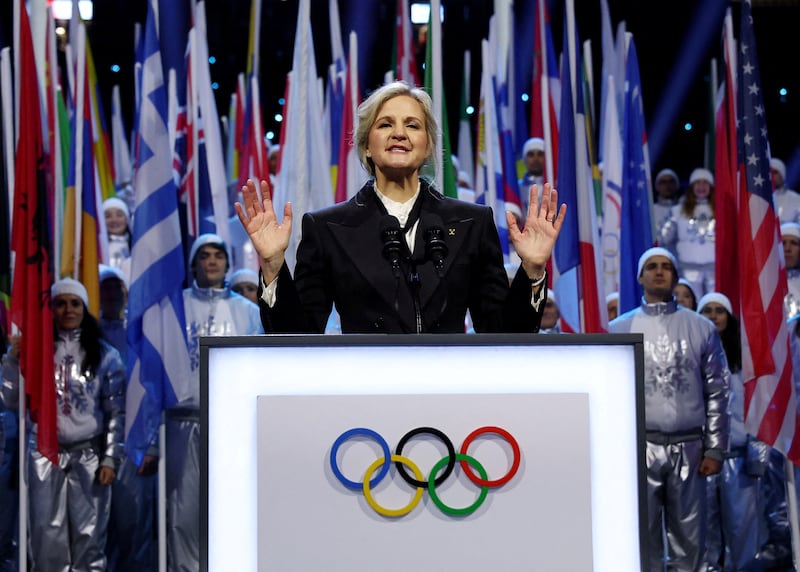

Should athletes at the Olympics get paid?
International Olympic Committee President Kirsty Coventry’s recent response to that question generated enough backlash that she’s now posted what amounts to a clarification on social media.
Coventry, an Olympic champion swimmer for her home country of Zimbabwe, said in the post to the IOC’s Instagram account for its athlete portal that she was only talking about prize money when she told New Zealand’s Sport Nation recently, “I don’t believe in paying athletes.”
She added in that interview, “I come from a small country, I came from a sport that doesn’t necessarily pay athletes very well and I still don’t think we should be paying athletes at the Olympic Games.”
In her post to athletes, Coventry said she’s always been opposed to prize money at the Olympics, “as this would only benefit a very small number of athletes” and that she’s “absolutely committed to finding more ways to directly support athletes on their journey.”
The role of the Switzerland-based IOC, Coventry said in the post, “is to find ways to directly support a large number of athletes on their journey to becoming Olympians, at the Olympics and as they transition into life after sport.”
It is not clear whether any changes will be proposed when the IOC meets later this month to consider the remaining results of a series of policy reviews ordered by Coventry shortly after she took office nearly a year ago as the organization’s first woman and first African leader.
Do some Olympians get paid?
While athletes are not paid by the IOC to participate in the Games, the organization does provide funding to national Olympic committees that can be used for direct assistance through what’s known as the Olympic Solidarity program.
Ahead of the 2024 Summer Games in Paris, the IOC reported a total of 1,560 athletes from 195 countries along with 215 teams from 140 countries received some $40 million in scholarships for their training.
Some athletes who win Olympic medals do receive cash. World Athletics became the first international federation to award prize money at the Olympics, $50,000 for winning gold at each of the track and field events at the Paris Games.
Various national Olympic committees offered payouts for gold medalists in 2024, ranging from $768,000 for first-place finishers from Hong Kong to $13,000 for those from Australia, according to a list compiled by CNBC.
The U.S. Olympic and Paralympic Committee has paid Team USA athletes who won gold $37,500, while a silver medalist got $22,500 and a bronze winner, $15,000. The USOPC is also using a $100 million donation to give all Olympic participants $200,000 in future benefits.
How athletes are responding to the IOC position on payment
Athletes still opposed Coventry’s stand even after her explanation.
Australian Olympic champion swimmer Cameron McEvoy responded on Instagram, claiming that paying every athlete at the Games $10,000 “as an appearance fee” plus up to $100,000 in prize money for a podium finish would add up to about 1.5% of the IOC’s quadrennial revenues.
“For reference the NBA has a 50% revenue share with the players. You can have prize money and pay all athletes to help those who aren’t are the absolute top and still be extremely comfortable with your boatloads of revenue,” McEvoy wrote.
Another Olympic champion swimmer, Great Britain’s Matthew Richards, responded to Coventry’s post by raising concerns about the IOC’s restrictions against Olympians monetizing “their own name and likeness during the Games.”
The IOC, he posted, “generates billions from athlete performances while the athletes themselves are left hoping a sponsor notices them. This statement doesn’t change the fact that the people creating all the value are the only ones not sharing in it.”
Coventry was asked in New Zealand about the IOC not compensating athletes for the use of name, image and likeness (NIL) during a Games, given the huge shift in American college sports that allows athletes to profit.
Her response, Sport Nation reported, was that the IOC should not adopt anything similar.
Olympians “get beautiful venues. They get beautiful villages. They get a beautiful experience. And all of that comes from the money that we raise,” Coventry said, adding that the Games is a “very particular” model.
“Now, if the entire movement wants us to change, we would have not as many countries, we’d have not many sports, we’d be very particular on what that would look like. I don’t think that’s the Olympic Games and I don’t think the Olympic movement thinks that’s the Olympic Games.”