

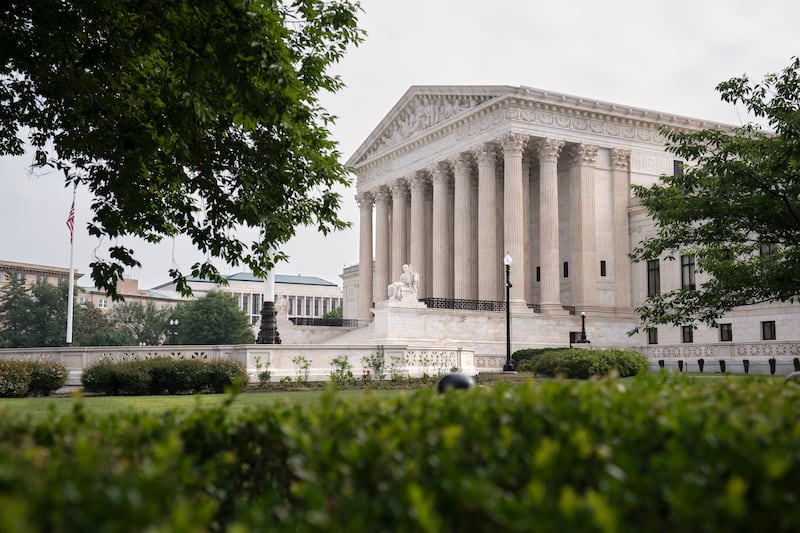
The U.S. Supreme Court should correct the ongoing problem of judges subtly replacing believers’ understanding of what their religion requires with the judge’s own beliefs while evaluating religious liberty cases.
It was a problem when judges imposed their own theological interpretations on nuns during the height of the contraceptive mandates under President Obama. And it’s a problem today when judges tell a Native American church to just go worship somewhere else, even though the church believes certain ceremonies can only be done at one place on earth.
When you go before a judge, it is well-established law that the judge is not supposed to decide whether your religious beliefs are right or wrong, wise or foolish, logical or nonsensical. Judges are not supposed to substitute their own religious beliefs or theological interpretations for those of the litigants in their courtroom. As the Supreme Court has said, “Courts are not arbiters of scriptural interpretation.” They are simply not competent to evaluate religious beliefs.
So, when someone brings a case arguing that the government is infringing on religious liberty, judges should tread carefully. The law allows judges to consider whether a person is sincere in his religious beliefs — does this person truly believe what he says he believes or is this a sham? That’s generally a permissible line of inquiry.
However, what a judge can’t do is substitute their own religious beliefs or theological interpretations for those of the litigants in the courtroom. Although this is a well-established principle, in practice, judges sometimes cross the line.
We saw this during the height of the contraceptive mandate legal battles. The Little Sisters of the Poor and many others held sincere religious objections to funding or participating in providing contraceptives as a part of health plans offered to their employees. They testified that offering the contraceptives as a part of their health plan made them morally complicit in something that they believed went against their religious beliefs.
Yet, judge after judge ruled that the nuns’ religious beliefs were not burdened by the government forcing them to provide contraceptives in their health plans because the judges thought, when you look at it a certain way, the nuns were far enough removed from the provision of contraceptives to not be morally implicated. But that’s not the right question. It’s not the place for judges to say at what point you should feel morally complicit. That’s a theological judgment fundamentally prohibited by the First Amendment.
The contraceptive mandates wound their way up to the U.S. Supreme Court, but with the passing of Justice Scalia on the precipice of a ruling, the cases never came to a full resolution on this issue — punting the question for another day.
Now’s the time for the Supreme Court to address this subtle, reoccurring problem.
The University of Texas Law and Religion Clinic, along with my firm First Liberty Institute, are asking the Supreme Court to take up a case involving a sacred Native American site. Our clients, Gary Perez and Matilde Torres are ceremonial leaders of the Lipan Native American Church whose ancestors worshipped at a sacred site located at a bend in the San Antonio River within Brackenridge Park, Texas.
Church members believe the trees and the cormorant birds that nest near the river are a bridge between this world and the afterlife, and worshippers cannot properly perform religious ceremonies without specific trees and nesting cormorants.
In 2022, the City of San Antonio announced “reformation efforts,” which included uprooting most of the trees and deploying pyrotechnics, clappers, lasers and other means to keep the cormorants away. Because the church’s religious ceremonies are so tied to the land, the trees, and the nesting cormorants, the city’s plan to alter Brackenridge Park fundamentally destroys their ability to practice their religion.
Yet, district court and appellate court judges have told them that their religion is not substantially burdened because they can worship elsewhere. This is an improper judicial imposition of the judges’ own theological reasoning for the believers’.
Six judges on the U.S. Court of Appeals for the Fifth Circuit would have ruled in favor of the Native American church. In a powerful dissenting opinion, Judge Andrew Oldham wrote, “To put it quite simply, plaintiffs will be unable to practice their faith if the City’s plans go forward. If that is not a substantial burden, I do not know what is.” The dissent elaborates, “And if the government were to padlock a church on the theory that Christians could worship elsewhere, we would not hesitate to hold it unlawful.”
This week, a diversity of groups including The Association on American Indian Affairs, Comanche Nation, Jewish Coalition for Religious Liberty and the Sikh Coalition asked the court to take the case.
The Supreme Court should do so, clarify the law here, and protect religious liberty for all Americans.