

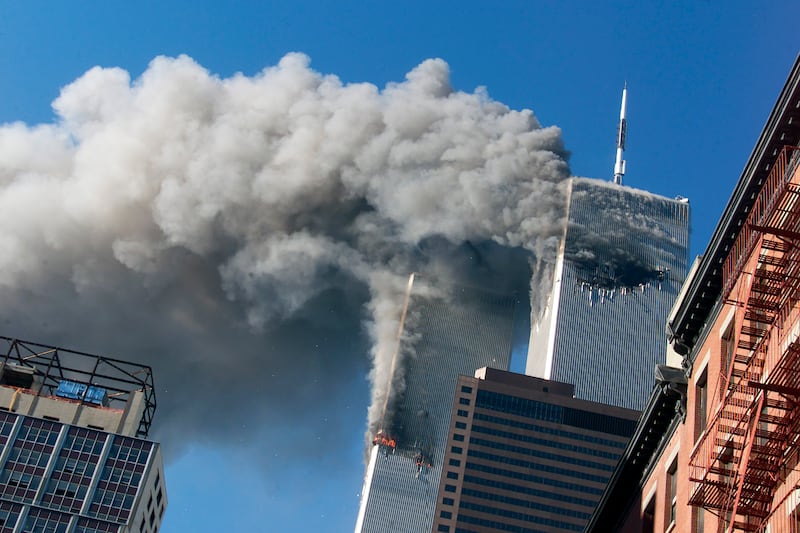

I could not sleep on the night of Sept. 11, 2001, so I penned a letter to my young daughters — 2 years old and 8 weeks old. “I am writing to tell you of this day, a day you will not remember but has changed the world you live in forever.”
I wrote of watching on television as terrorists crashed two commercial airliners into the World Trade Center in New York City and a third into the Pentagon in Washington, D.C., and about a fourth airliner that crashed in rural Pennsylvania.
The day brought with it feelings of grief and fear — “grief for those that died and fear that as a result of this day others will die.” I wrote about looking off our back deck; “it seemed as if the world had stopped; even the streets in Utah were quiet.”
For my daughters, it was an ordinary day; my older daughter played with toys and on her grandparents’ swing set. For my husband and me, the day was marked by desperation to do something, while knowing that we could do very little.
My husband, a Delta Air Lines employee, was told not to report for work. I was a newspaper reporter on maternity leave. We thought about giving blood, but the lines at the Red Cross were three to four hours long.
So we listened.
“We listened to President George W. Bush speak to the American people and assure us that the terrorists would be caught and punished,” I wrote. “We listened to (Latter-day Saint prophet) President Gordon B. Hinckley speak at a special memorial service in the Tabernacle during which the Tabernacle Choir performed patriotic anthems and songs of peace. We heard statements from the governor of Utah and countless national congressional leaders. We talked to friends and family on the telephone. We listened to continuous press reports. We watched video on the TV that showed the disasters over and over again.”
Are we still listening?
Reading that letter almost 25 years later is sobering. Are we any better off today than we were a quarter of a century ago?
There is much to worry over and argue about.
We all have opinions about the ICE raids and immigration, the Lindsay Clancy mistrial, a new ballroom at the White House, the Iran war and the final second of a Michigan football game. We debate over the morality of politicians or if morality even matters in the year 2026. And we fight over money, debt and the value of institutions — universities, religions, governments and even newspapers.
But every once in a while, something causes us to pause.
Just one year ago this week, I was in Switzerland. Traveling in a car packed with people, we learned about the shooting of Charlie Kirk. Opinions flew as the volume in the car increased and tension grew heated. Everyone had something to say about violence in America and how it escalates.
Then a simple statement stilled us: “He is a father,” one woman said of Kirk.
Almost instantly the conversation stopped and, for a few seconds — reminiscent of 9/11 — everyone listened to the silence.
There is power when we unite around the things that make us human.
‘I am human’
On a cool morning in northern Iraq in late 2014, I walked across the Bajed Kandala 2 camp, observing the thousands of internally displaced people — almost all Yazidi — who had found refuge in the tent city.

On that day, there were 16,000 people — almost all women and children — waiting for their daily bread. But the equipment in the camp bakery had broken before the baking cycle was complete.
So even as the smell of fresh bread lingered, no one ate.
“If we distribute bread to some part (of the camp) and not the entire camp, we will have a problem,” explained surgeon Nemam Ghafouri, who ran the camp. “And the next time when we distribute, everybody will come and attack because they think there is not enough for everybody.”
She had made a most difficult decision, the kind of decision that defines leadership. Order for all was more important than nourishment for a few.
This week, as we mark the anniversary of the Charlie Kirk shooting and of 9/11, and as war continues to rage in the Middle East not far from that very camp in northern Iraq, my thoughts have turned to Ghafouri.
Ghafouri is Muslim and the people she was helping were Yazidi — two groups that have much to disagree about. Yet, when I asked how Ghafouri overcame the religious and political tensions in the region, she spoke of meeting a Yazidi boy. “The first time he introduced himself to me, he said, ‘I am human.’ He called himself human.”
Ribbons and prayers
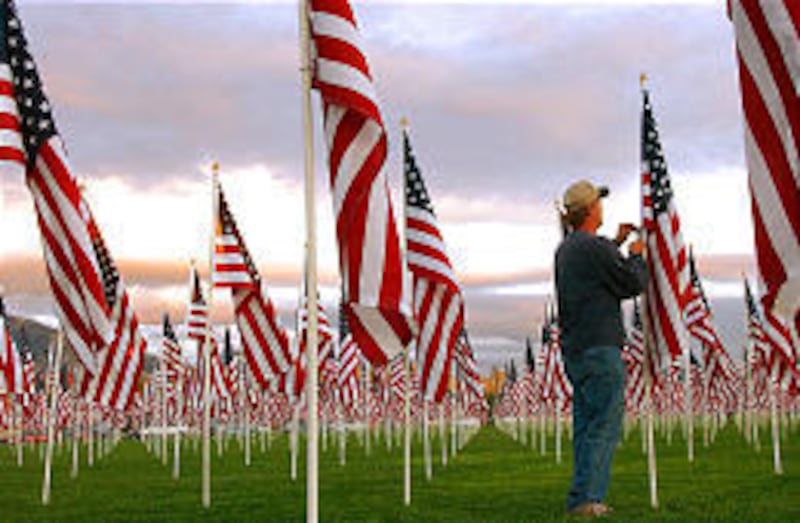
Humanity has spilled into my own community twice in recent months as my neighbors filled our streets with ribbons — both times to comfort grieving families who lost children. The ribbons were a manifestation of a community recognizing the grief and fear and uncertainty in the world. Seeing the ribbons reminded me of driving the streets after 9/11 and seeing hundreds of American flags.

In a quiet, understated way, ribbons and flags are both evidence that even in hard times, humanity triumphs and people show up for one another.
The Deseret News had three journalists — all under the age of 25 — who witnessed the Charlie Kirk shooting. As they spoke in interviews after the shooting about the fear, chaos and tragedy of the moment, one theme rose again and again:
They prayed.
In the seconds after witnessing the political violence, as they lay on the ground seeking safety and trying to make sense of the awful scene before them, they prayed. Not for themselves. But for Charlie Kirk and his family.
I have forgotten many of the details of Sept. 11, 2001. But the letter I penned to my daughters 25 years ago reminds me again how my family found peace the same way.
“Tonight we don’t know why or how this has happened or if it will happen again,” I wrote. “All we know is that we love each other, both of you, and this country. Tonight we pray for the victims. Tonight we pray for this nation and its people. Tonight we pray for you and your future.”