


President Donald Trump called in Wednesday morning for an interview with Glenn Beck, where they talked about the possibility of changing beef processing regulations, the death of Dolly Parton and foreign relations with Russia and Iran.
Beck, a conservative commentator who previously ran talk shows on CNN and Fox News, brought up the topic when Trump began talking about affordability and prices “coming down very rapidly” across different sectors amid the war with Iran.
“I inherited high prices ... and we’ve really gotten them down,” Trump said, adding about Iran, “Don’t forget, when we, when I did this, people thought the oil would go to $10 a gallon.”
“But we had to do it. We had to stop them from having a nuclear weapon, and we did. And the prices are coming down very rapidly,” he continued. “And now beef is starting to come down ... you know, the means, the beef has started to come down.”
Beck is also a rancher, with cattle and other livestock on his ranch in Idaho, which came up during his conversation with the president.
The developing drama with beef
The response from Trump about beef prices comes as he decided to pause tariffs on beef imports. He announced on Friday that they would permit up to 300,000 metric tons of beef to be imported to the the United States over the next three months without tariffs.
The announcement was met with pushback from the cattle industry and Republicans who represent large agricultural communities.
The decision appeared to be a way to try and lower costs across the country before the November midterm elections, but some of the president’s closest allies, like Wyoming Sen. John Barrasso, argued it would undercut U.S. production in favor of other countries.
“Americans want U.S. beef on the table – not foreign imports,” Barrasso said in a statement. “Wyoming ranches produce the highest-quality beef in the world.”
“It needs to be easier – not harder – for Wyoming ranchers to feed America.”
Beck noted during the interview with Trump that he didn’t plan on talking to the president about the issue of beef after the announcement, but as a rancher, he nearly begged Trump to “please, please” look at the “cartel that is the meat processing cartel.”
“I run a ranch, so I know what it’s like, and I’m telling you, it is the processing plants,” Beck said, adding there’s just a few plants in the U.S. and they are “not even American” and he believes they are colluding.
“Help us, help us!” Beck said. “It’s so we can’t ... butcher with all of the federal regulations. It is really hard, you know. If there’s something you can do to help.”
Beck went on to confirm that it’s a regulation issue and the “inspections are insane.”
Trump asked if ranchers needed the strong regulations for meat processing and Beck told him to “break the back” of the beef processing plants because there are ranchers across the country that want to build their own plants but the regulations are “just killing us.”
“You’re saying, with less regulation, you think that the ranchers and farmers would do a very good job of processing the beef?” Trump questioned.
They talked about the Department of Agriculture and the Food and Drug Administration being the ones controlling the current regulations.
“This is a very big thing you just told me, though, because you just gave me a very good idea,” Trump said. “Okay, good, good, very good. I love the call. I love this call.”
In a statement to the Deseret News, a spokesperson for the USDA said, “The Trump Administration and Secretary Rollins have already made historic progress in supporting small and very small processors. USDA has taken concrete steps to ease regulatory burdens and expand processing capacity, including implementing the Small Processor Action Plan.”
Agriculture Secretary Brooke Rollins addressed the media on Tuesday amid the trade war with Canada, but declined to say which countries the U.S. would be working with under Trump’s new beef import plan.
She acknowledged that there were “a lot of unknowns” for agriculture as the trade war with Canada heightens over tariffs. “There’s no doubt” it causes concern for American farmers and ranchers, she said.
When asked last week about which countries the U.S. made a deal with to import beef, Trump said he didn’t want to say. On Tuesday, Rollins said she was “not privy” to talk about which countries and directed the question to U.S. Trade Representative Jamieson Greer, who was having ongoing conversation and “finalizing what exactly that looks like.”
Foreign relations: Trump pressed on Canada, Iran, Russia
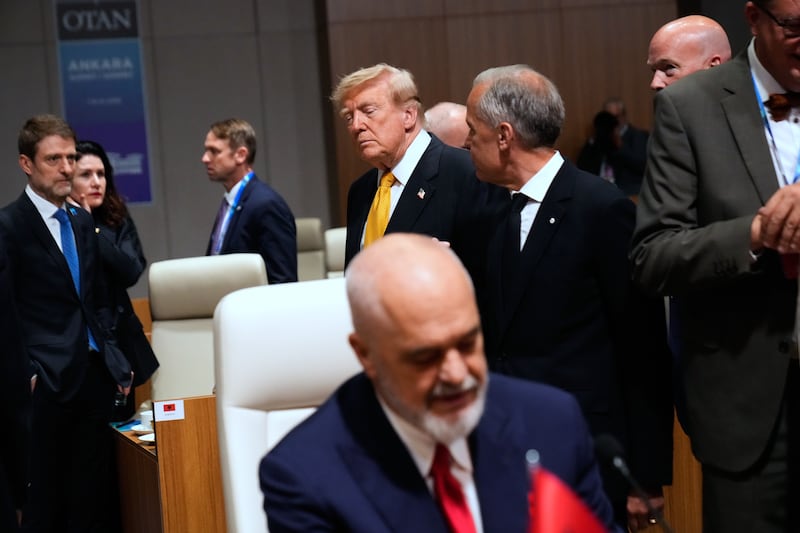
Beck and Trump pivoted from beef to foreign issues.
In the past few days, tensions have emerged with Canada after trade negotiations fell apart, leaving the two sides in a bitter battle that’s included name calling, reciprocal tariffs and uncertainty about if the two long-standing allies will be able to find a much-needed agreement.
Canadian Prime Minister Mark Carney walked away from tariff negotiations over the weekend, saying U.S. demands were unacceptable and threatened Canadian sovereignty.
Carney argued the United States “asked too much and offered too little,” going as far to say the two countries were in an economic war.
Beck asked Trump whether Canadians are trying to throw the Republican Party’s chances in the midterm elections because it seemed like they had a good deal on the table. He wondered if there was a way to end the fight with Canada by November.
“They are one of the worst countries in the world to deal with,” Trump replied. “This has gone on for many years.”
They both said the Carney administration is “terrible,” and Trump reiterated a previous talking point that Canada has “taken advantage” of the U.S. for decades.
Beck also pressed Trump on the trip that CIA Director John Ratcliffe made to Russia. Ratcliffe was reportedly in Moscow on Tuesday, marking a rare visit from a top U.S. agency official to the country as the war with Ukraine drags through its 5th year.
“Can you tell me why our CIA director flew in the middle of the night to meet with the Russians?” Beck asked.
Trump dismissed some rumors and said Ratcliffe was in Russia for a “very sort of semi-routine” visit.
“We would like to see the war with Ukraine end. That’s a war that would have never started, Glenn, if I were president,” the president said.
Ratcliffe, Trump said, is a “fantastic guy” and was not in Russia for any of the rumored reasons. Still, Trump said, “something may come out .. of it.”
“We’re working very hard to get that war ended, and frankly, they both want to see it ended at this point,” he said.
One of the biggest stressors for the president leading up to the November midterms is the stalemate with Iran. It’s something polling, both in Utah and nationwide, shows voters are concerned about and tired of.
Experts say Trump is stuck in a difficult spot because the war doesn’t seem to be on track to be resolved. The president, however, told Beck on Wednesday that he thinks it will be ending “fairly soon.”
Beck asked about rumors and speculation, particularly after The Atlantic reported that Tehran is “abuzz” with talk about the Supreme Leader’s death.
Trump dismissed the rumors, saying he thinks that Ayatollah Mojtaba Khamenei isn’t dead, but has very serious injuries to the left side of his body, “the arm, the leg, the whole thing.”
“But, I don’t think he’s dead. And if he is, they’re putting on a pretty good show,” the president said. “We had the victory in Venezuela and we’re going to have a big victory here very soon.”
Beck pushed back on the president, noting that the Iranians the administration are negotiating with are not like “Western-minded people.”
He wondered if any country, not necessarily the U.S., would help the Iranian citizens to “stand up” and revolt against the Ayatollah. Trump highlighted how unsafe a revolt would be since protesters are being shot and killed, but still projected confidence that Iran’s military has been badly hurt by the U.S. military operation.
Trump orders flags to half-staff to honor Dolly Parton
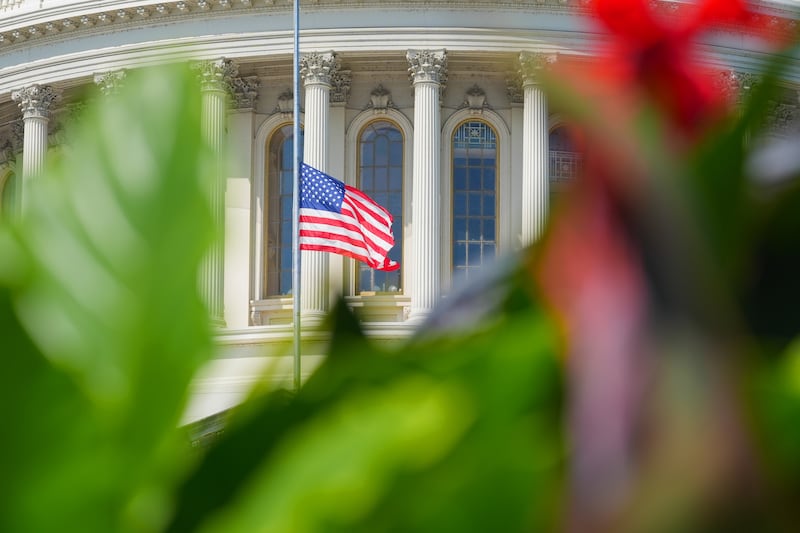
Beck opened the interview by noting how Trump made the decision to order all American flags to be flown at half-staff in memory of Dolly Parton, who died Tuesday at the age of 80.
Beck highlighted the unusual move by the president to lower flags for someone who was not an prominent national or state political figure.
“I feel like she’s kind of, you know, like I feel about her the way I felt about Queen Elizabeth. She was just such class,” Beck said.
“She was unique,” Trump replied. “I mean, she was amazing, and to lose her, it’s like you lose a member of the family.”
“We all knew her so well, I knew her a little bit,” he continued. “She wasn’t a very political person. She really liked me, I will tell you.”
That comment earned a laugh from Beck. Parton, amid her death, is being honored as the one thing — and maybe one of the last things — that most Americans could agree on. She refused to pick a political side, noting she has fans on both sides of the aisle and wanted to keep her beliefs private.
She was offered the Presidential Medal of Freedom in 2021 by the Trump administration but didn’t travel due to the COVID-19 pandemic. She was later a co-founder of the Moderna vaccine, and the Biden administration offered her the award but she said she felt like if she took the honor, it would be wading into partisan politics.
Parton was famously-known for her country hits but also her philanthropy. Through her library program, she provided more than 300 million books to children around the world.
“She was just a nice person,” Trump told Beck. “I liked her a lot, and I thought it was a natural thing to lower the flags.”