

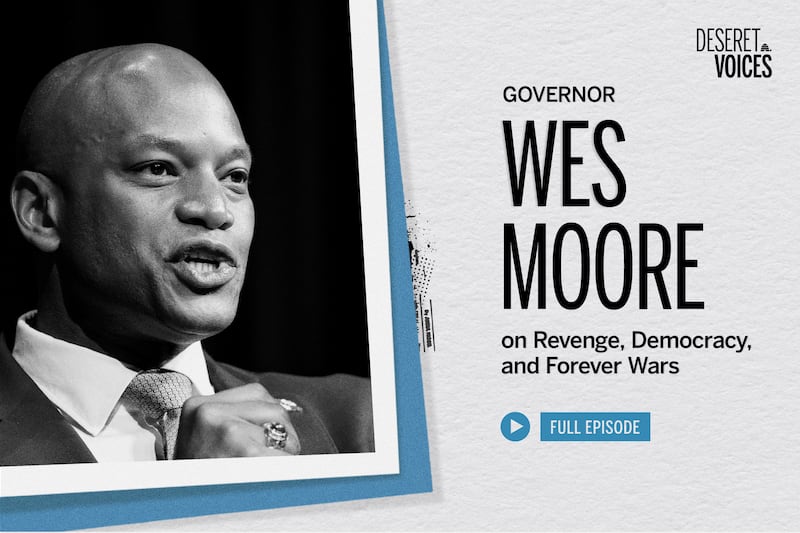


Maryland Gov. Wes Moore partnered with Utah Gov. Spencer Cox on the “Disagree Better” initiative.
In the political boxing ring, one thing Moore says he doesn’t agree with is the concept of “sitting on your hands while getting punched in the face,” which is what he feels the Democratic Party is being asked to do.
On this episode of “Deseret Voices,” Moore talks with McKay Coppins about redistricting, ICE at polling locations and the ongoing conflict in Iran.
Subscribe to “Deseret Voices” on YouTube, Apple Podcasts or Spotify.
Note: Transcript edited by Steven Watkins.
McKay Coppins: Gov. Moore, thank you for coming on “Deseret Voices.”
Gov. Wes Moore: It’s my pleasure. Great to be with you.
MC: So you and Spencer Cox, governor of Utah, have become genuine friends. I think he actually is the one who introduced me to you the first time years ago. And you spend a lot of time talking about how Americans can disagree better. And I want to start with this: What is the biggest thing that you and Gov. Cox disagree about?
WM: Well, you know, so first I tell you how I first met him was at what something called “baby governor school,” which is the National Governors Association. Rolls all the new governors together, and he was the chair. And he was like — and remember, I’ve never run for office in my life. So this was all brand new to me. And like I show up, and I’m looking at all these governors here, and Spencer and his wife, Abby, they come up to me and my wife, and they were so kind. You know, at a time when it still was, like, all brand new. And we just got very, very close, and we just stayed very, very close.
And the beautiful thing about for me and Spencer is there’s a whole lot that we might disagree on when it comes to a policy issue. There are certain issues I could spend three hours talking to Spencer about, and I know that he’s going to walk away saying, “Wes, I love you, but you didn’t move me on it.” And there might be certain issues that he is like, “Wes, I really think X, Y, and Z,” and I’m like, “Spencer, I’m with you, man.”
But it’s like I think about issues like, for example, I’m a person who believes that a woman has a fundamental right to choose what happens with her body, right? And I know I could talk to him for five hours, I’m not going to move him on it, right?
And I know he’s someone who — I believe as someone who owns firearms myself and I believe in responsible gun ownership — but I think that there need to be commonsense gun laws being put in place because also I’ve come up in neighborhoods and communities where I’ve seen gun violence just ravage communities.
And I know that there are certain things he could try to tell me we should X, Y, Z, and I’m like, “Spencer, I’m with you, but I’m not going to go where you are.” But at the end of the day, though, that’s still my guy. And like he’s someone who I like, and I trust, and I lean on, and I hope and pray that he knows he can do the same thing for me. And so we never are disagreeable, even if there might be an issue where we’re like, “Yeah, you know, we’re probably not there on that issue together.” But that’s OK.
And I think about my work in the military: I never once asked my soldiers, “What’s your political party?” And I think that Spencer Cox probably took the same type of approach when you think about his history and background as well.
MC: Have you ever had an argument about politics where one of you actually did change the other’s mind?
WM: That’s an interesting question. I think there’s definitely been arguments where he’s shaped the way I can think about things differently. I think there’s definitely been arguments where we’ve been able to come — where he’s been able to expand my mind on something, and I really appreciate that.
I mean, for example, as part of the NGA, we’ve been doing a lot of work together on issues like immigration, where we know that we both believe that we have to have a secure border. We both believe that we have to make sure we get violent offenders and violent criminals out of our communities, no matter their immigration status. We both believe that states should actually have real authority when it comes to workforce visas and work visas, because what Spencer’s going to need in Utah is going to be different than what I’m going to need in Maryland in terms of the type of commerce and the type of jobs that immigration can help support.
We might have disagreement on where I believe that if a person’s been here for years and for decades and they’re raising their family and got their kids, I believe that we should have a pathway to citizenship for them, right? I’m not sure if that’s where he is, but I know that the stuff that we agree on — making sure we secure borders, making sure you can get rid of violent offenders, making sure that states have a greater level of autonomy when it comes to workforce visas — the stuff we agree on is much more numerous than the stuff we might have a measurement of disagreement on, and that’s why I think we’re able to make progress.
MC: Immigration really is one of those issues where, as contentious and divisive as it is, I have found that if you actually get into a good-faith conversation with somebody who disagrees with you, you find that you actually have a lot more in common than you realize, from a values perspective. Maybe not a policy perspective, but most decent people can see both sides of that issue, right?
WM: Absolutely. And it’s funny because one of the reasons that I love the National Governors Association — and I’m grateful that the job that Spencer had when I first became the governor is the job that I have now, where the other governors elected me to become the chair of the National Governors Association — where we’re able to actually make progress on things because governors don’t do ideologicals. Like, we’re not ideologues. We all got to balance budgets. We all got to make sure we’re taking care of our people. We all got to work together with both Democrats and Republicans.
Washington, D.C., oftentimes seems performative. Washington, D.C., oftentimes seems like people are just simply doing it for clicks or trying to do it so they can talk about something on cable news shows. Governors don’t have that flexibility, and governors don’t have that ambition. We just want to do what’s right. And so I do love the fact that as governors, we’re able to come together and work on issues — issues like immigration, issues like what’s the importance of state rights inside these moments and voting rights — on things that for a lot of time seem that Washington just seems completely incapable of making progress on.
MC: You have talked a lot about how your party has struggled to connect with some people who are in President Trump’s space. What do you think Democrats fundamentally misunderstand about people who voted for Donald Trump?
WM: I think part of the reason that a lot of Democrats misunderstand them is Democrats don’t talk to them. You know what I mean? Like, “Those are the folks over there,” without understanding that the same — the type of frustrations that a lot of them feel, it’s not just that it’s real, oftentimes it’s justified. Like, I’m not going to sit there and defend a system that’s indefensible.

It’s the same way when people say, “I was never tapped by the Democratic Party to run for governor.” I’d never run for political office before in my life. In fact, when I started running, no one paid attention to me because I was at 1%. And when I finally started getting momentum, it wasn’t like the Democratic Party was like, “Oh, this is great.” In fact, the Democratic Party put millions of dollars to try to stop me once I started gaining momentum. And so, but I think part of it was that I said, I think the cynicism that people feel is real, and it’s justified. And it’s why people can say that “I am willing to go for the person who will tell me not ‘I can fix the system,’ but the person who can tell me ‘I uniquely can blow it up.’” And that starts sounding attractive.
And so I just think that I want people — and I never want people to lose that cynicism. I tell people all the time, like, I’m the governor, and I’m still cynical. I’m still skeptical. But I want that skepticism to be my companion and not be my captor. I don’t want that skepticism to be the thing that tells me to opt out, or tells me the thing that I’m now going to become a political nihilist. I want them to say like — and I want for, frankly, for the Democratic Party to stop being this party of “no” and “slow,” and start being the party of “yes” and “now.” Because if you can address the issues that are actually impacting people’s lives, you no longer have a messaging problem. You’ve fixed your messaging problem with results. But you can never mask a results problem with a messaging fix. And that’s what I think a lot of people get wrong.
MC: The hard part of this whole “disagree better” idea is that I think everybody believes that the other side started it, right? Like, Republicans say Democrats broke this norm, and Democrats say they’re responding to Trump, and every escalation becomes a justification for the next one, right? And I’m curious, now that you’re in this position of not only running a state, but you’re also, like you said, running the National Governors Association, you’re talking to governors across the country. Do you have thoughts about how you can actually break that cycle without unilaterally disarming?
WM: Well, you know, I think that part of it is I don’t think we should be getting into the blame game. Because I think that there’s enough blame to go around that that just becomes a circular firing squad. You know, when I think about repair, the idea of repair for me does not mean, or does not start with, seeking revenge.
I have two middle names. My full name is Wesley Watende Omari Moore. And my mom wanted one, my dad wanted one, so they just gave me both. And so the name my dad wanted to give me is Watende. And Watende means “revenge will not be sought.” And it’s very much the — you know, and I believe names have meanings.
A lot of stuff we do with our young men and boys within Maryland, we talk about this a lot. Where I actually believe that’s right: that revenge will not be sought. Because revenge is not a prerequisite for repair. I think you can never forget, but at the same time, it’s not something that can slow or stunt your momentum towards progress. That building a society where everyone is seen and where everyone is supported. Building a society where people feel that they have a real pathway to work and wages and wealth. Building a place where all of our people — but particularly where we can invite our young men and boys to be a part of a conversation instead of feeling like they are a problem that has to be solved.
These are the type of things that I think we collectively can do. And if we spend all of our time trying to come up with the best quip to show that the other side is the reason we’re here, or saying that, “They started it,” I think what ends up happening is that we all end up looking like children, and we never get to a point that we can make real progress.
MC: I think there’s a lot of wisdom there. I just want to ask you about one place where I think putting it into practice is really complicated, which is this whole redistricting battle that the country has been in the middle of, right? So you have argued that Maryland can’t sit on its hands while Republicans in other states redraw their congressional maps to advantage Republicans, right? A critic would look at that and say, isn’t this exactly the cycle of escalation that we’re talking about, right? They did it; therefore we have to do it too. What would you say to that?
WM: I would say I’m not doing it because I’m seeking revenge. I’m doing it because I’m trying to defend our democracy, which I truly and fundamentally believe that it is being robbed in front of us. I believe in national redistricting reform. I believe that this country needs to do it. I believe Congress needs to pass it.
And I’m being very honest, and I will say it over and over and over again, that regardless of what happens, if the Democrats control the House in 2030 and we do another census, you know what I would say? We need national redistricting reform, even if it means Democrats lose seats. Because I believe that that’s what our country needs. That the fact that we have 92% of our congressional districts are not competitive — so if you’re a Democrat, you’re more worried about someone coming at you from the left; if you’re a Republican, you’re worried about someone coming at you from the right; but if you make it through your primary, you’re good, you’ve nothing to worry about — and only 8% of our seats are even competitive in the first place, there’s something fundamentally broken with that type of system. So we need national redistricting reform.
However, what I also know is this: For the past year, Donald Trump has been trying to manipulate elections in his favor to try to make this pain permanent. Like, what do we think when he’s talking about nationalizing elections is — even though, by the way, that is actually unconstitutional? When he’s talking about eliminating mail-in balloting — which, by the way, we sued him for and beat him in court? Or when he’s talking about putting federal agents to make sure we have safe elections, which is voter intimidation? Or when he’s talking about telling he wants access to our ballot boxes, which is illegal? Or when he says he wants Republican states to redistrict, do mid-decade redistricting, but Democratic states should sit on their hands?
Like, that’s something I have never understood the concept of: sitting on your hands while getting punched in the face. I’ve never understood this as a strategy or a tactic. And so I don’t think that we should be a part of this conversation because I’m seeking revenge. I believe we need to be part of the conversation because I’m seeking to protect our freedoms and our democracy. And when we can get to the other side of this mountain, absolutely, we need to make sure we’re doing national redistricting reform. But we got to get to that other side of the mountain first.
MC: You brought it up; let’s talk about the midterm elections. And, you know, you have said in the past that you’re very concerned about President Trump attempting to interfere in those elections. What kind of interference are you most worried about? I mean, we did just see Gen. Dan Caine says there’s no plans to send troops or National Guard personnel to polling places — something that in the past we would not have had to worry about, but of course —
WM: It’s amazing that that had to come from the chairman of the Joint Chiefs of Staff.
MC: I’m glad — you know, I think we can all say that we’re glad to hear that’s the case. But, you know, what are you worried about? Is it ICE showing up at polling places? Is it federal law enforcement being sent? What kind of interference are you most worried about?
WM: Well, and I’m actually, I’m smiling, but I’m being very serious: The fact that the chairman of the Joint Chiefs of Staff said that we’re not going to violate the Constitution should say something. Because what he’s talking about that they won’t do; it would be unconstitutional. The thing that I’m worried about is I’ve seen how unbelievably creative that this administration has been to do something that is against the law. And I just think we need to be prepared.
Now, the thing that I’ve said — and I’ve said this both as the chair of the National Governors Association and to both my Democratic and Republican colleagues, because to be clear, this is not a partisan issue; I have spoken with almost just as many Republicans on this as Democrats on this, who are all — who are concerned that this idea of state rights and the idea that elections are run by the states is something that this administration does not seem to understand — and so the message I’ve said to my fellow governors, and the message I’ve sent to our attorneys general and our secretaries of state is: Know your power. Know your Constitution. These are state-run functions. The president of the United States does not get to determine what elections look like in Maryland, and, frankly, neither do I. Neither does the governor. We have an independent election commission that controls all of our elections. Let them do their job.
So I want our governors to know their power. But I also want the people in our states to know their power, too. Because the best way you can combat the chance of election tomfoolery is win overwhelmingly. Show up and vote. Because if you can do that, an overwhelming win will show people that you cannot rig nor mess with our elections. If we have a strong voter turnout, that is one of the greatest messages that you can send to anybody who’s trying to use their power or their influence to try to make this pain permanent and rig elections.
MC: What instructions are you giving to Maryland officials to prepare for between now and Nov. 3? Are there specific scenarios that you’re instructing them for?

WM: I mean, we’re battle-boarding a whole bunch of different scenarios. All we’re simply saying is there are a whole variety of scenarios that have one universal goal: We want free, fair and safe elections in our state, just like we’ve always had free, fair and safe elections in our state. That’s the guidance. We’re not asking for anything else. We’re not asking for something new. Free, fair and safe elections inside of the state of Maryland, and knowing that our democratic vote and our democratic voice is not just going to be heard, but no matter what the vote says, it’s going to be respected and it’s going to be implemented. And so that’s the thing that we are preparing for, and we’re preparing for multiple scenarios, but we’re just preparing to make sure that that commitment that we have to our people will never be violated.
MC: You mentioned that you’re hearing from other governors who are concerned about this. Are some of those governors Republican? Are Republican governors coming to you and saying, “We are worried about the Trump administration’s efforts to kind of federalize the midterm elections”?
WM: Oh, there’s absolutely governors that are concerned. And it’s not just about the elections. It’s attempting to trample on states’ rights. Because it is important for people to remember that the ability to vote and have that being a state function, it’s not that it’s just kind of like important, it’s actually literally in the Bill of Rights. It’s in the first 10 amendments. That’s how important this was to the Founding Fathers that they said, “We are going to make it in our first 10 things that we are saying is going to be the laws of this new land: state rights.” Because they were always fearful of a tyrannical and dominating executive, right? So they wanted to make sure that the states had individual powers that were constitutionally protected. That was a core tenant of the birth of this new nation. And amongst those rights that they have is voting. Because they never wanted a tyrannical executive to be able to try to take control of that. And so I think that is something that for both Democratic and Republican governors, that we’re not just taking seriously, but we’re making sure that we’re protecting.
MC: I mean, it’s a traditionally conservative argument, at least in the last few decades, right? The idea that the states should be protected from overreach from the federal government was something you’d hear from like the Tea Party 15 years ago.
WM: Exactly! Exactly. That we do not want big government and a dominating federal government to be able to trample on our individual state rights. So it’s pretty amazing how the hat has moved to another head now.
MC: I’m curious where you draw the line between legitimate federal enforcement of election law and illegitimate federal interference. To you, what are the red flags that Americans should be looking out for?
WM: Well, for me, it’s not even what my opinion is. It’s the law. And it’s what courts and judges have continued to say is what actually falls under the individual jurisdictions of the states. And unless there is a reason or a need for some type of interference or support, this is something that for hundreds of years, the states have got this.
And I would say that for all the people who say, “Well, there was interference in 2020.” Again, there were dozens of court cases on this, and every single one of them said the same thing. And we’re talking about Trump-appointed judges who said the same thing: where there was no interference, there were no stolen elections. That our states have a unique responsibility and have been doing a good job at this for years. And you know why they’ve been doing a good job in this? Because they’ve just simply been following the law. And so I know where I stand on this, and my answer is very easy: I stand with the Constitution. I stand with the fact that the Maryland Elections Commission, they’ve got this, and they know what they need to do in order to run free and fair and safe elections. And I feel like for us and for every single state and for every single state chief executive, you need to be able to follow that same guidance.
MC: You said you’re kind of gaming out the various scenarios. I’ll just ask you point-blank: If federal law enforcement or immigration agents show up at polling places with the apparent goal of intimidation, what would you do as governor?
WM: That will be against the law, and we will enforce the law.
MC: What does that look like?
WM: We will enforce the law.
MC: I do want to ask you about Iran as well. You know, back in April, you said that you were worried that we were lurching toward another forever war in Iran. Today, American forces are again striking Iranian targets; Iran is retaliating; fighting is escalating. We’re six months in. Has anything happened that changes your assessment?
WM: Not at all. I’m actually — I hate being right on this. I wanted to be proven wrong. But I’m not. It’s being validated.
And this is the danger of forever wars. This is the danger of wars where you watch the target continue to move. This is the danger of fighting wars where you do not involve the American people, and you just simply ask them to keep on paying for it. This is the danger of forever wars where you’re not building an international coalition and you all are united on a singular target and a single goal or a single aim.
And unfortunately, I know this from experience, I’m very proud to be a U.S. Army veteran and a combat veteran in a combat zone of Afghanistan, where I served with the 82nd Airborne Division. A war that we were always taught and understood that would be quick, and that war lasted 20 years. That war was done under a premise that we could not tolerate the Taliban being in charge of Afghanistan, particularly they were the ones who harbored al-Qaida, who then attacked the United States on 9/11. And we lost thousands of American service people in that war. We spent trillions of dollars. And do you know who’s in charge of Afghanistan right now? The Taliban.
MC: How does that feel for you? I’ve talked to other veterans who served there, and obviously watching the Taliban take over that country after decades spent there is — “disappointing” is not a strong enough word. For you, how does it feel?
WM: I’m furious. I was furious watching our exit. I was furious watching how that took place. And I don’t know if I’m ever going to get rid of it. And I don’t know if I should.
Because good people were lost, and shouldn’t have been. And particularly for something where we watched administration after administration — Democrats and Republicans — who still could not fully articulate to the American people why this was worth our blood and treasure. And I think right now we are watching that with this administration in spades, where we’re repeatedly being asked to pay for something that you’re not explaining what it is we’re actually paying for.
MC: I was going to ask you: If a member of the 82nd Airborne came to you today and said, “Governor, what is our mission in Iran?” What would you tell him?
WM: I would tell them the same thing that I said six months ago: I don’t know. I don’t know what we’re doing. I don’t know how you’re planning on hitting a target when you don’t even know what the target looks like. I don’t know how you’re planning on getting to a resolution when you don’t even know what a resolution sounds like.
And here’s the thing: It’s like, one side can start a war. That’s easy. Generally, one side doesn’t end one. And I think that’s what Donald Trump is learning. And he never learned it because he never served. But the thing I wish he would have understood, and I wish the people around him would have done a better job explaining to him is: You know what? You can start this. You can start this, and Bibi Netanyahu can start this, but you know who’s going to have a say when this war ends? Israel. And Iran. And Pakistan. And Lebanon. And Saudis. And the Russians. Like, you don’t get to unilaterally say when this war ends. That’s the problem with war. That’s why foreign wars are so dangerous. And that’s why they’re so complicated. Because when you’re in, you’re in. And you don’t get a chance to determine when that war ends, or where it goes, or where it spirals, or who it’s actually benefiting. Because the truth is, there are international partners right now who are benefiting from this, and they have no interest in seeing it come to an end anytime soon. That is the definition of a quagmire.
MC: If you were in Congress, would you vote to prohibit further offensive military actions in Iran until Congress has a new authorization for war?
WM: If you cannot explain to me what the mission is, I don’t know what you’re asking me to pay for. You know, it’s the reason I just — I don’t believe in the idea of just signing blank checks to anybody. I don’t believe in unconditional aid. I don’t believe in any of that stuff, because I don’t do it in Maryland. These are taxpayer dollars. This is money that the people of my state are trusting me and my colleagues with.
And the idea that we would just simply say, “Yeah, we’ll just keep on funding whatever it is that we’re funding just because,” as if it’s your money, does not make sense to me. And so my urge to the people of Congress is: You cannot sign off on things that you cannot explain or articulate. If you cannot go back to your district, or if you can’t go back to your state and say, “This is exactly what we’re doing, and this is exactly how the money’s being used, and these are the expectations that we have,” then for me, it’s actually a pretty easy answer. It’s not terribly complicated at all.

MC: I know you’re almost out of time here, and I want you to note that I did not ask you if you’re planning to run for president in 2028. I have more dignity than that. Although I will tell you that I think that the first time I met you that night, we were at some dinner party in Washington or something, Spencer Cox pulled me aside and said — you know, there were a lot of important, powerful people in the room — and he said, “There’s one future president in this room. It’s that guy over there,” and he pointed at you. So take that —
WM: I hope he was pointing to a mirror! I think Spencer should do it.
MC: Oh yeah? Let’s make some news right now! You want Spencer Cox to run for president?
WM: Let’s make some news! I’m announcing: Spencer Cox is running for president. [Laughter.]
MC: No, look, my last question is: Let’s just go back to where we started this conversation, which is about our political culture, which I think basically everyone in this country is exhausted by. You see it in conversations that you have, I’m sure, with the people in your life. I hear it all the time when I tell people that I’m a political journalist. It’s a combination of people wanting to fight with me and also run away, right? I guess I just want to know what you have learned in your time in politics about how to fix our political culture, or if not fully fix it, make it 20% less exhausting. Is there anything that would surprise people in terms of what you’ve learned about how we can make our politics just a little bit easier to take?
WM: Wow. I’d say, we have to remember that sometimes the loud does not mean the many. There are 15% of the population on both sides that are very loud, and are very disruptive, and oftentimes are not looking for a solution. They just enjoy and they relish in the chaos. And I think that is real.
I also would say that that’s 15% on both sides, but let’s not forget about the 70. The 70% of this country who’s just living their life. They’re just taking their kids to school in the morning. Then they’re going off to their job that they wish would be paying them a little bit more. And then maybe they’re taking their kids to their Little League game or dance practice afterwards. They’re hoping that maybe they can get a chance every once in a while to take their family out to dinner. That they’re talking to their kids about college, but then by the time their kids go to sleep, they’re nervous about how they’re going to pay for it. The people who are worried about losing their healthcare if they lose their job, or the people who are worried about the fact that gas prices are so high that they don’t even have the money to be able to go to that doctor’s appointment in the first place. And they feel like the world is just spinning very fast and they’re no longer in control. That’s 70% of this country.
And I think we get very caught up on the 15s. We get very caught up on the noise. And I would just ask people who sit in these seats — even for myself who’s new to this again. I never, you know, I didn’t think that this was going to be my destiny; I haven’t gone from office to office to office to office or anything along those lines. Just never forget who put you there in the first place, and never forget why you did it in the first place, right?
I did it because I wanted to focus on child poverty. I did it because I knew that for stories like mine — a kid who grew up raised by an immigrant single mom, who had handcuffs on his wrists by the time he was 11 years old, that joined the Army at 17, that graduated from a two-year college, and now serves as the 63rd governor of the state of Maryland — that my story should not have to be an exception. That our job is to try to make sure that we get more kids who actually have a chance to achieve their God-given destiny.
And that’s the thing I’ve continued to learn is: Don’t get confused, and don’t get it twisted, and do not let things that don’t matter too much matter too much. Don’t forget why you got into this business in the first place. And I think if you do that, you’re actually going to be able to honor your legacy and honor the promises you made that gave people the confidence to put you there.
MC: Gov. Moore, thank you for coming on “Deseret Voices.” I appreciate it.
WM: I appreciate you, McKay. Thanks, man.